
 EN
EN  FR
FR 
Beware the hype of ai-powered solutions
AI is now front and center in the media spotlight, capturing the attention of numerous executives. Yet this excitement often comes with genuine confusion about its value for SMEs. Many equate AI and automation with mere "gadgets" and unclear promises. However, the real issue isn't the technology itself : technological integration alone isn't enough to revolutionize a business.
In truth, the impact of AI entirely depends onthe way it is intergrated within your company to optimize and solve concrete business problems as well as, become a lever for growth.
- A Measurable ROI Automation that delivers clear and quick returns (time, cost, quality) justifies the investment. For instance, automating lead management with tools like n8n or Make.com can reduce lost business opportunities.
- It addresses a Current Pain Point: The key is to identify repetitive tasks without high added value and high-impact processes. This begs the question: Would my company (or department) gain in productivity or sales if I outsourced this task to AI?
- A scalable solution : An effective solution must be able to grow as the company expands. Is the chosen AI solution scalable?
This is where true value of an AI automation agency lies for your business. With the right partner, SMEs can streamline and transform the AI buzz into a sustainable competitive advantage.

Understanding the Role of an AI Automation Agency
An agency specializing in AI and automation supports SMEs in their digital transformation AI by optimizing their business processes with intelligent technologies.
It helps to :
- Identify automation opportunities to save time and reduce repetitive tasks.
- Implement customized solutionstailored to the specific needs of each company
- Enhance productivity and quality of operations by integrating intelligent tools (chatbots, RPA, data analysis, apis etc.).
- Provide technical and strategic supportfrom system design to maintenance.
- Boost innovation and competitiveness for SMEs in their market using AI.
AI agencies clearly stand apart from IT service companiesgeneral consulting firms or freelancers:
- IT services companies (or ESNs) often work on large IT projects but don't always offer deep expertise in artificial intelligence or automation.
- Traditional consulting firms provide strategic diagnostics but don't necessarily integrate the technical implementation of AI or operational automation.
- Freelancers offer flexibility but sometimes lack the resources to tackle real transformation challenges at the SME scale.
There are several types of IA automation agencies:
- Generalists : cover all sectors for varied projects.
- Specialized : focus on one area (marketing, finance, supply chain…).
- Tailored : small teams with AI experts, often for bespoke solutions.
- Pure players : exclusively AI & automation, sometimes with their own tech stack (source).
Their key mission goes beyond mere tool integration. Success depends on :
- A precise diagnosis of business processes : identifying real bottlenecks with workshops and concrete data analyses.
- Business prioritization : each custom AI automation is aligned with an economic goal (time savings, cost reduction, sales cycle acceleration, NPS increase…).
- Tailor-made support : team training, tool adaptation, and skill transfer to ensure autonomy.

Why use an AI Automation Agency? Strategic Benefits for SMEs
Outsourcing automation and AI gives SMEs an immediate growth boost, avoiding the long and uncertain cycles of doing it in-house.
- Rapid deployment : An AI automation agency leverages proven frameworks and tools like n8n or Make.com to launch projects within weeks, whereas recruiting or developing internal skills can take months.
- Accelerated time-to-value : You quickly gain measurable results (automations, dashboards, AI assistants) without waiting for your team's expertise to ramp up.
- Access to cutting-edge skills : Recruiting in data science, RPA or NLP is expensive and rare. An agency pools these talents, making it possible to integrate the latest advances (e.g. integration ofOpenAI for automatic document generation).
- Multi-sector feedback : Agencies capitalize on use cases across different sectors.
The figures speak for themselves:
- In industry, one player reduced its production cycles by 20 % thanks to the automation of quality reporting (gains measured in less than 8 weeks).
- In the services sector, integrating AI assistants for customer support increased NPS satisfaction by 15 points while halving the cost per ticket.
- In retail, an SME doubled its e-commerce conversion rate by connecting its tools via Make.com to personalize product recommendations. Make.com to personalize product recommendations.
By considering your AI automation agency as a strategic partner, you transform every project into a measurable growth accelerator, rather than just a technical experiment.

AI Automation services: From workflow automation solutions to process automation and AI agents
The strength of an agency IA automation lies in its ability to articulate advanced technologies around your business challenges.
Intelligent automation goes far beyond traditional macros or scripts. Today, it encompasses:
- RPA (Robotic Process Automation) : Executes repetitive tasks on your existing systems without human intervention by mimicking human actions.
- AI agents and assistants : Capable of engaging in conversation, handling complex requests, and evolving through machine learning
- Automated workflows : Connects your key applications (e.g., CRM, ERP, HR tools) and automates actions with AI-driven decision-making.
- Connected bots : Provide 24/7 customer support or accelerate lead management [Marketing Management].
- Computer vision : Automate document verification, logistics management, or quality control.
- Custom App and Solution Development : Integrate workflows, dashboards, and SaaS solutions (such as invoicing or video creation tools).

A Successful AI Automation Project: Key Steps for Maximizing Business Impact and Minimizing Risks
A successful AI automation project relies on a structured approach designed to maximize business impact and minimize risks. Every step matters, from the initial framing to continuous improvement.
- Strategic Audit & Framing : The process begins with an in-depth audit of existing processes, business constraints, and available data. The key: is identifying high-potential automation areas and anticipating their impacts on teams and the organization.
- Co-creation of KPIs: Success indicators (KPIs) shouldn't be imposed externally. They are defined with the business units,aligning AI objectives with real business priorities such as time savings, error reduction, and improved customer service.
- Prototyping & POC : Instead of aiming for immediate large-scale deployment, a targeted Proof of Concept (POC) validates both technical feasibility and user acceptance. For instance, automating report generation using tools like n8n or Make.com using different ai models can yield tangible results in just a few weeks.
- Pilot deployment : : Once the POC is validated, automation is deployed on a limited scale. Why? To measure real impact, refine workflows, and mitigate resistance to change.
- Agile Measurement & Adjustment: Continuously monitoring KPIs and adapting swiftly is crucial. A practical example: adjusting the prompt of an OpenAI or chatgpt assistant to enhance response quality based on user feedback.
- Scaling & support : Successful automation gradually extends to other teams or processes. Responsive support and tailored training ensure internal adoption and skill development.
- Continuous Evolution : As technology and business needs evolve, oversight doesn’t end with delivery. Maintaining active monitoring and regularly reassessing outcomes and usage secures sustained value creation.

Evaluating the Quality of an AI & Automation Agency
Visit quality of an AI & automation agency is measured against concrete, verifiable criteria. Always employ a methodical and evidence-based approach when comparing potential partners.
- Industry experience : A relevant agency must have piloted projects in contexts similar to yours. Ask for dcustomer cases and make sure she understands the issues specific to your sector.
- Portfolio & References : Examine the diversity and depth of their achievements. A robust portfolio, supported by credible testimonials, provides confidence in their ability to deliver.
- Demonstrated ROI : Ask for quantified examples: how much time or cost was saved? A serious agency will be able to provide you with before-and-after KPIs for comparable projects.
- Methodological transparency : Clarity on the steps (audit, prototyping, deployment, maintenance) is crucial. Favor partners who detail their governance and cost structure.
- Agency benchmark : Compare the strengths and specialties of various providers. For instance, some agencies excel in integrating n8n workflows, while others specialize in optimization through OpenAI or legacy ERP expertise.
Avoiding Costly Mistakes : Many companies find themselves trapped by superficial choices or poor risk analysis.
- Excessive technicalism: Beware of overly technical discussions that lack a clear connection to your business objectives. Automation should never be an end in itself, but rather a lever for measurable growth or savings.
- Experience in the field : Does the agency and the person you're dealing with have the technical background and experience to understand your challenges? Prioritize AI expertise.
- Supplier dependence : : Opt for open or transferable ai systems. Ask who owns the scripts, access, and documentation. This minimizes the risk of being locked into a single provider.
- Integration with existing systems : Question the agency's ability to interface new tools with your ERP, CRM, or business software. Any automation must fit into your current IT landscape without creating silos.
Always ask yourself these key questions before making a commitment:
- What business KPIs is the agency committed to improving?
- Which tools (e.g. Make.com, OpenAI, n8n) will be used, and why?
- How will you ensure that your in-house teams develop their skills?
- Does the agency have any real on-code and AI experts?
A rational and well-documented choice shields you from the pitfalls of technological hype and maximizes sustainable value creation.

The Value of AI Automation Goes Beyond the Cost of Technical Deployment
How to measure the ROI ? For SMEs, understanding cost structures and anticipating return on investment (ROI) can transform an expenditure into a lever for sustainable growth.
Decoding Billing Models
- Fixed Price : A set payment, ideal for well-defined projects. Benefit: budget predictability. Limitation: may underestimate complexity or changes along the way.
- Time & Materials (TMS) / To success / Success-Based: Billing based on time spent or results achieved. Benefit: agility and continuous adjustment. Caution: requires careful project management.
- Subscription : Recurring payment for access to tools or platforms (e.g., Make.com). Benefit: cost smoothing and scalability.
- Variable Share of ROI : Payment indexed to the value generated (e.g., share of savings or additional revenue). Benefit: strong alignment with performance.
Beyond the Contract, Consider Hidden Costs:
- Maintenance and updates of workflows
- Integration with existing systems (ERP, CRM, API)
- Training teams to use solutions (OpenAI, n8n, etc.)
ROI Calculation Methodologies Specific to AI Automation
A relevant ROI relies on concrete operational indicators. . It's not enough to measure time savings; each automation must be linked to a tangible business impact.
- Processing cycle : How many days or hours saved per automated process?
- Value per FTE : How many employees could be redeployed to higher-value tasks?
- Error rate : Reduction of manual errors and associated costs (e.g., billing, data entry)
- Customer churn : Can automation improve retention by speeding up request processing?
Practical tools to facilitate assessment:
- Customized dashboards to compare performance before and after automation
- Integrated ROI simulators to model different scenarios

Choosing Between an AI Automation Agency, In-House Development, or Traditional Consulting
Deciding between an AI automation agency, in-house development, or traditional consulting can significantly impact the digital trajectory of a small to medium-sized enterprise. Each option comes with tangible considerations: agility, expertise, cost, and operational impact.
- AI Automation Agency : Ideal for quickly accessing cross-disciplinary experts and cutting-edge tools (e.g., n8n, Make.com, OpenAI), without the need for internal recruitment or training. This option enables you to prototype, deploy, and iterate on real business use cases, often with reduced timelines.
- In-House Development: You maintain full control and build strategic expertise. This route requires investment in recruitment, training, and staying updated with technology trends. Implementation timelines are generally longer, and there is a higher risk of error or technical obsolescence for an SME without a dedicated team.
- Traditional Consulting: These firms offer a structured approach, often focused on analysis and strategy. They excel in framing issues but frequently outsource technical implementation. Their value is strong in vision, less so in agile execution or practical automation.
Key Questions to Consider:
- Does my organization have the internal resources (time, budget, skills) to develop and maintain AI/automation solutions?
- Is the need primarily for strategic ideation or for the rapid execution of pilot projects with operational impact?
- What is my tolerance for risk regarding dependency on external partners?
Summary Comparison Table:
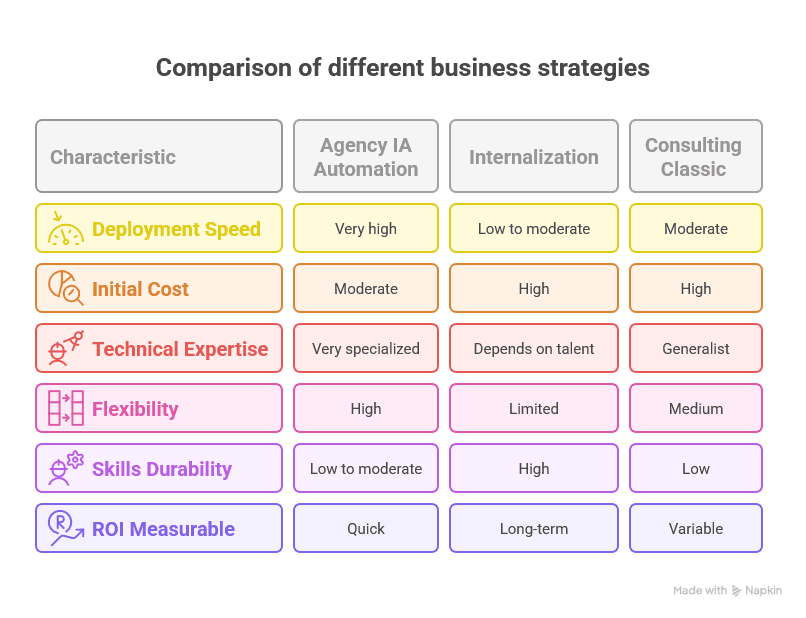
The optimal choice depends on your digital maturity, ambitions, and desired level of autonomy. Balancing speed, cost, and sustainability should guide your decision.

Trends and Future of AI Automation for SMEs
Small and medium-sized enterprises (SMEs) are stepping into a new era where generative AI and advanced automation become strategic levers, far beyond mere cost reduction.
Emerging technologies, such as autonomous AI agents and intelligent co-pilots, are transforming the way teams work. For example, it's already possible to integrate an autonomous agent via OpenAI to instantly analyze incoming leads, then orchestrate personalized follow-up in Make.com or n8n.
- Adopting these tools means faster decision-making and greater operational precision.
- SMEs that structure their processes around these new applications experience accelerated business cycles and enriched customer experiences.
Responsible automation is becoming essential. Leaders must ask key questions:
- How can compliance be ensured in light of evolving European AI regulations?
- What is the social impact of automation on teams? What skills need to be developed internally?
- How do we measure the value created by each automation, beyond just the cost savings?
Over the next 3 to 5 years, three major disruptions are anticipated:
- Technology: The rise of autonomous workflows and the democratization of generative AI will enable SMEs to automate tasks previously deemed too complex or specialized.
- Regulation: The AI Act and other European frameworks will impose strict standards on transparency and data management. SMEs must anticipate these requirements to avoid disruptions or legal risks.
- Talent: Hybrid profiles—capable of managing AI automation projects while understanding business challenges—will be in high demand. Investing in internal skill development will be a decisive competitive advantage.
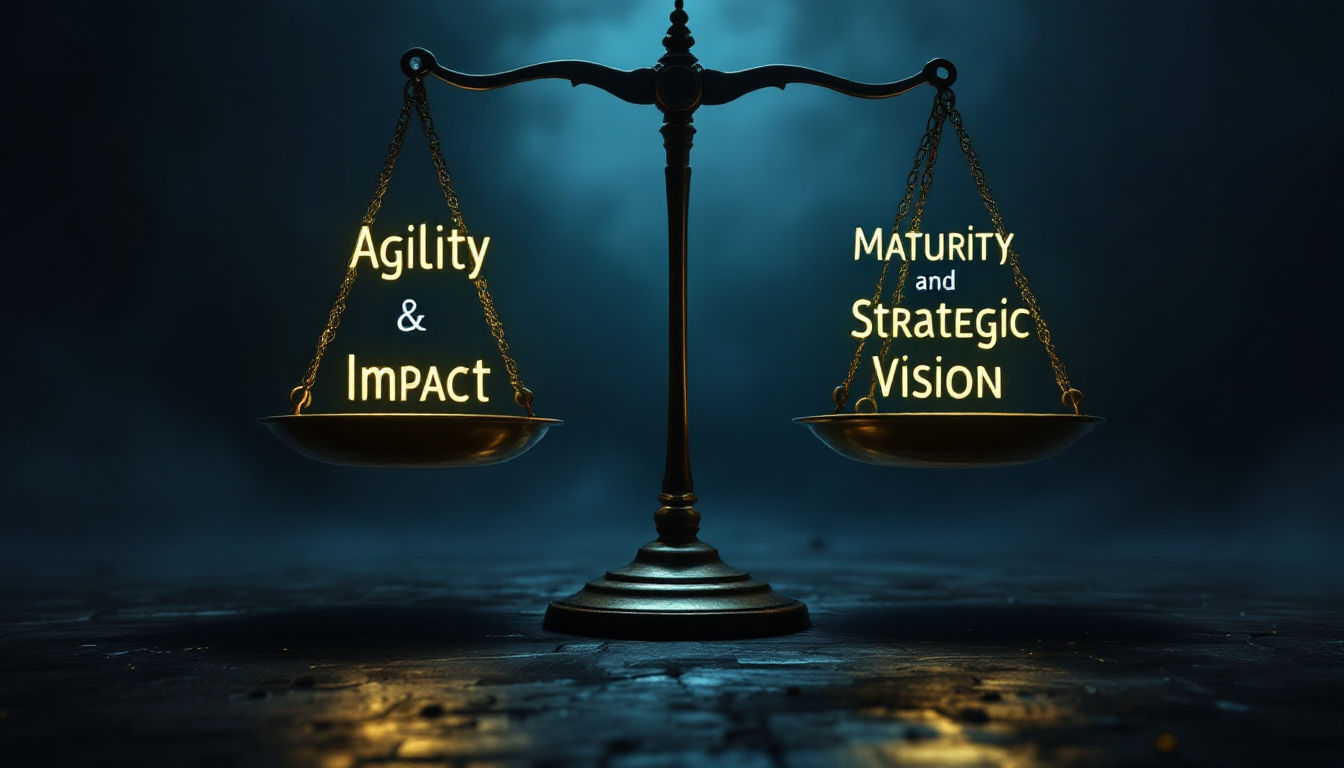
The real challenge: managing AI and automation as value-driven investments, not just tech gimmicks. The SMEs that succeed will be those that align innovation with measurable business impact and responsibility.
Frequently asked Questions (FAQ)
When should an SME equip itself?
As soon as a process starts hindering growth or unnecessarily consuming human resources, automation becomes relevant. The right time is when administrative tasks, lead management, or report generation slow down performance. Ask yourself: "If this process were 80% faster, what would we gain?"
How long for ROI?
With modern tools like n8n, Make.com, and OpenAI, return on investment can be evident within weeks to a few months. The timeline depends on the level of automation, the volume of tasks, and integration with your existing IT systems. A project focused on a repetitive task often provides nearly immediate ROI.
What are the first businesses to be automated?
Sectors dominated by manual data entry, data management or recurring tasks:
- Customer relations (emails, tickets, reminders)
- Accounting and invoicing.
- Digital marketing (automated sends, lead scoring)
- Logistics operations (order tracking, notifications)
Always target functions where time savings are accompanied by error reduction..
Can we stay in control without a technical team?
Yes, thanks to no-code/low-code platforms like n8n and Make.com, business teams can manage their own automations. However, plan for a gradual skill development. Autonomy requires documented processes and clear governance.
Is it possible to evaluate a POC before making a commitment?
A Proof of Concept (POC) is essential to assess the viability of an AI or automation project.. It enables :
- Evaluate the real impact on a specific business flow
- Quantify potential savings
- Test compatibility with your existing tools
Always request a POC that is limited in time and cost to validate the potential before any large-scale deployment..
What if the project fails?
Temporary failure is part of the innovation process.. Analyze :
- The causes (poor targeting, technical integration, lack of buy-in)
- Generated learning (what are the warning signs for the future?)
Iterate quickly, adjust the scope, or pivot the solution. Agility and user feedback are your best tools for bouncing back.